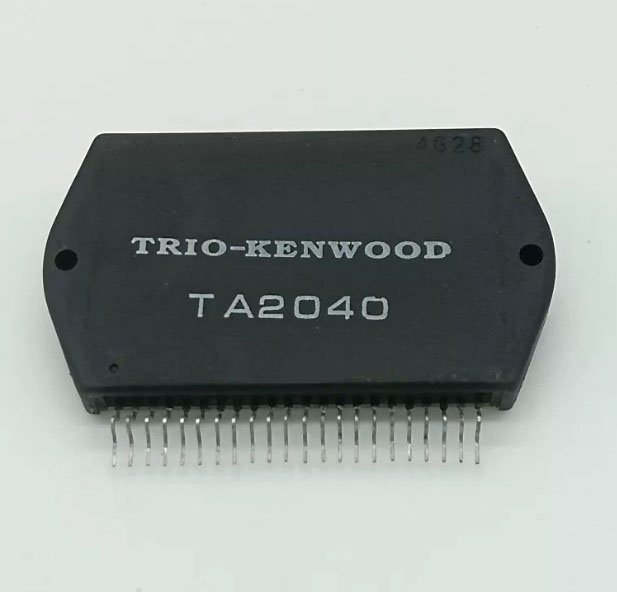
KENWOOD TA2040 MODULE – Original Power Amplifier IC (ZIP‑16 Package)
If your classic Kenwood amplifier has suddenly stopped producing sound, stays stuck in protection mode, or makes strange noises when you power it up, the culprit could be a faulty power amplifier IC. This genuine KENWOOD TA2040 MODULE is a direct replacement for the original hybrid power amplifier integrated circuit found in many high‑end Kenwood audio components from the 1980s and 1990s.
This is not a cheap aftermarket copy and not a refurbished pull from unknown sources. It is a legitimate, brand‑new component manufactured to original specifications, designed to restore your vintage Kenwood gear to its original sound quality and reliability. A service manual is available upon request to guide you through the installation process.
| Product Type | Power Amplifier IC / Hybrid Module |
|---|---|
| Package Type | ZIP‑16 (Zig‑zag In‑line Package, 16 pins) |
| Output Power | 20W – 30W (upgraded version of TA2030) |
| Compatible Models (partial list) | Kenwood KA‑92b, KA‑880SD, Basic M1A, and other Kenwood amplifiers using TA2040 / TA2030 pairs |
| Design Features | Class‑D / high‑efficiency design, used in Kenwood’s DLD (Dynamic Linear Drive) bias circuit, often paired with TA2030 for rail‑switching topology |
| Common Failure Symptoms | No audio output, amplifier stuck in protection mode (flashing red light), distorted or intermittent sound, overheating of the IC module |
| Service Manual | Available upon request – ask for the download link |
| Installation Note | Direct replacement – matches original mounting holes and pinout. Requires soldering. For experienced technicians or advanced DIYers only. |
Why Your Kenwood Amplifier Needs This Exact TA2040 Module
The TA2040 is a relatively rare, highly specialized hybrid IC used by Kenwood in their higher‑end amplifiers of the late 80s and 90s. It is often paired with a TA2030 IC in a unique **DLD (Dynamic Linear Drive) rail‑switching** topology, a proprietary Kenwood design that improves efficiency and reduces heat while maintaining high‑quality audio reproduction[reference:0]. Unlike standard off‑the‑shelf amplifier chips, the TA2040 was custom‑specified for these specific Kenwood circuits. Using a generic or incorrect replacement part will not work – the amplifier may fail its protection self‑check, refuse to power on, or produce permanently distorted sound.
As an upgraded version of the earlier TA2030, the TA2040 delivers 20–30 watts of clean output power and offers improved dynamic response, deeper bass extension, and clearer mid‑high frequency reproduction – making it essential for restoring the original sonic character of these classic Kenwood amplifiers[reference:1]. It is housed in a ZIP‑16 (Zig‑zag In‑line Package), a 16‑pin through‑hole package that was commonly used for power hybrid ICs during that era.
Known Applications & Compatible Equipment
This TA2040 module is a known replacement part for several Kenwood amplifiers, including but not limited to:
- Kenwood KA‑92b – integrated amplifier (two TA2040 units used, often with TA2030 companion ICs)[reference:2]
- Kenwood KA‑880SD – high‑power integrated amplifier (TA2040 / TA2030 pair)[reference:3]
- Kenwood Basic M1A – power amplifier module[reference:4]
- Kenwood 990 series – where TA2040 is paired with TA2030 in a DLD bias circuit configuration[reference:5]
- Various other Kenwood amplifiers and receivers from the late 1980s to mid‑1990s that utilize the TA2040 hybrid IC.
If you are unsure whether your specific model uses the TA2040, please refer to your amplifier’s service manual or inspect the existing IC on the main board – the part number is printed directly on the top surface of the black hybrid module.
Real‑World Signs Your TA2040 IC May Be Failing
- Protection mode activation – The amplifier powers on, but a flashing red protection LED prevents audio output (the relay does not click). In many Kenwood models, failed TA2040 or TA2030 ICs are a known cause of this issue[reference:6].
- No output on one or both channels – The unit powers up normally, but there is no sound from speakers or headphones, even with the volume turned up.
- Intermittent or distorted sound – Audio cuts in and out, or you hear crackling, popping, or heavily distorted output at low volumes.
- Overheating IC module – One of the TA2040 chips runs significantly hotter than the other (measured by touch or thermometer), indicating internal shorting or driver stage failure.
- Audible humming or buzzing – Unwanted noise appears even with no input signal connected.
- Physical damage – Cracks, burns, or discoloration on the IC casing are obvious signs of catastrophic failure.
If you are experiencing any of these symptoms after having already replaced capacitors and transistors in the power supply and driver stages, the TA2040 hybrid IC is a likely suspect. Replacing both the TA2040 and its companion TA2030 simultaneously is often recommended, as failure in one can stress the other.
Restore Your Kenwood Amplifier – Not the Whole Unit
Swapping the TA2040 module is an advanced repair that requires competent soldering skills and familiarity with high‑voltage amplifier circuits. The IC is a through‑hole component with 16 pins in a zig‑zag pattern, and its pins are relatively close together – care must be taken to avoid solder bridges[reference:7]. However, for experienced technicians, replacing this single component can bring a dead or malfunctioning classic Kenwood amplifier back to full working order at a fraction of the cost of replacing the entire unit. Do not scrap a perfectly good amplifier with a robust power supply and high‑quality components – just change the one hybrid IC that is most prone to age‑related failure. We also offer the companion TA2030 IC; please contact us if you need both modules for a complete restoration.
Note: This is a genuine replacement part manufactured to original specifications, but we strongly recommend verifying the part number on your existing TA2040 module before ordering. Installation requires advanced soldering skills; we are not responsible for damage caused by improper installation. If you are uncertain, please consult a qualified amplifier repair technician. Send us a photo of your existing IC if you need confirmation of compatibility.